Cart Total
$0.00
-
Your shopping cart is empty
Loading

Hello! Log in Your Account
New customer? Start here
|
4 min read
Contents
Quick Summary
The Telephone Preference Service (TPS) is UK register of phone numbers which have indicated that they do not want to receive unsolicited sales or marketing calls. Discover how Yay.com’s TPS Protection feature can help organisations increase credibility, improve productivity, and successfully avoid calling those numbers registered with the TPS.
Phone conversations and outreach marketing have a variety of roles to play in many businesses, whether that’s account management support, demand qualification or service clarification. For those businesses making sales and live marketing calls to potential consumers (B2C) or businesses (B2B), it’s important to ensure that the highest level of compliance and consent is followed wherever possible.
In terms of caller permissions, 'Do Not Call' lists offer individuals and businesses one of the best ways to exercise consent and to successfully opt out of receiving marketing calls.
In the UK, the Telephone Preference Service (TPS) and Corporate Telephone Preference Service (CTPS) are services that provide such a way for individuals and businesses to opt not to receive unsolicited direct marketing calls.
The Telephone Preference Service, commonly known as the TPS, is a central register containing a list of landline and mobile phone numbers which have indicated that they do not wish to receive unsolicited telemarketing phone calls.
The TPS is the UK's official 'Do Not Call' register of landline and mobile numbers belonging to individuals, including residential numbers, as well as numbers belonging to sole traders and partnerships.
It is free to register a number with the TPS, and doing so will reduce the number of unwanted marketing and sales calls. The Telephone Preference Service was created, and is run by, the Direct Marketing Association (DMA), with enforcement and related fines operated by the Information Commissioner's Office (ICO).
CTPS stands for Corporate Telephone Preference Service and is a similar ‘Do Not Call’ register to the TPS.
However, the difference between the CTPS and TPS is that the Corporate Telephone Preference Service is a register specifically intended for business numbers, such as those owned by limited companies, limited liability companies, and PLCs, but also numbers owned by schools, hospitals, government departments, and other public bodies.
Organisations are legally obligated to refrain from calling numbers registered with either the TPS or CTPS. Those that fail to respect the TPS and CTPS lists can be fined up to £500,000.
Ensuring that your organisation respects both the Telephone Preference Service and Corporate Telephone Preference Service can benefit your business by:
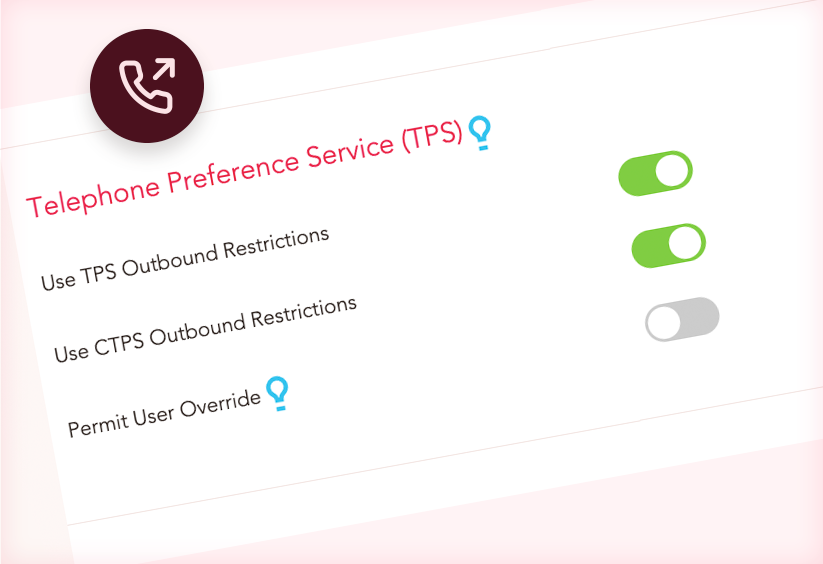
With Yay.com’s TPS Protection feature, it’s possible to ensure that your organisation avoids calling any phone numbers registered with either the TPS or CTPS.
While businesses are required to screen their marketing lists at least once every 28 days against the CTPS and TPS register, we are licensed with the TPS and our TPS Protection feature operates a lookup against the register each week to assist your business in remaining compliant.
Turning this feature on within your Yay.com phone system will screen and restrict calls only to those numbers not listed on either register.
With TPS Protection enabled, if your organisation does attempt to call a number that features on either the TPS or CTPS register, the caller will receive an audio notification as to why the call has been restricted and that particular outbound call will be blocked.
In cases where a number is not on the register, but that call recipient requests that you not to call them in future, their number can easily be added to an free phone system trial today and discover how we can immediately start to improve your marketing efforts and business communications.
Learn how to choose a phone number for your business. Enjoy the benefits of memorability, professionalism and more when you pick the right business phone number for your needs.
Posted January 15 2025 | 7 min

You use area codes all the time when calling from your phone or Cloud PBX, but when was the first call made using a UK STD area code? Find out here.
Revised February 4 2022 | 32 min

Virtual phone numbers are numbers not bound to a physical fixed landline or sim card. Find out how these flexible phone numbers can be a benefit to your business.
Revised November 19 2021 | 10 min

Exit codes and country codes: what are they, why do we need them and how do we use them?
Posted August 27 2021 | 5 min

With many types of phone number available, choosing the right one for your business isn't always easy. Today we help you decide which will be best for you.
Posted June 24 2021 | 5 min

If you're using a personal phone number, or too few business phone numbers, for your business, you're likely hurting instead of helping your bottom line.
Posted October 23 2020 | 4 min

Acquiring a business phone number need only take seconds. Not doing it will cost your business money. Here's why.
Posted July 7 2020 | 9 min

So you suddenly find yourself working remotely. Leverage modern technology and some international phone numbers and your business can grow its impact.
Posted April 1 2020 | 5 min

Your dashboard view of transferring phone numbers to Yay.com.
Posted December 6 2019 | 4 min
Find out how easy it is to transfer your current business phone numbers and benefit from our great call rates.
Posted June 3 2019 | 3 min
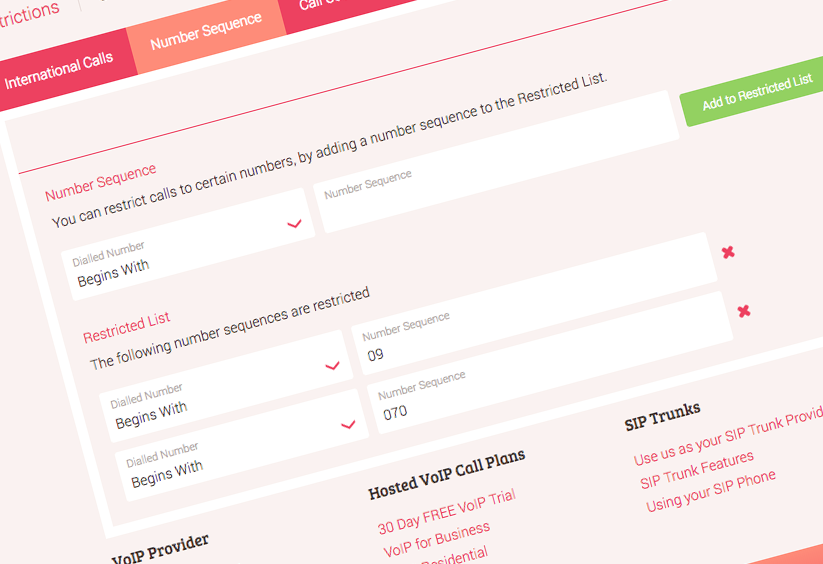
Enjoy control over your phone system and avoid unwanted VoIP call charges. Use your Cloud PBX to restrict premium rate call costs and block nuisance calls.
Posted December 8 2017 | 4 min

What makes a memorable phone number easier to remember? Learn how hosted VoIP and a memorable number can benefit your business.
Posted April 13 2017 | 4 min
We've made additional 01493, 01637, 01900 and 01569 area codes available, to provide you with more phone number choices for business and home.
Posted February 23 2017 | 3 min

Find out about 0203 London phone numbers, and how, with a VoIP phone system, they can help establish your business presence in the London and surrounding areas.
Posted January 11 2017 | 4 min

Find out how local phone numbers can be advantageous to your business. Couple with a VoIP phone system for further benefits.
Posted December 13 2016 | 3 min
What happens to my number if I don't pay my renewal?
Posted December 5 2016 | 1 min
Article By

Adrian
Digital Marketing at Yay.com
Share